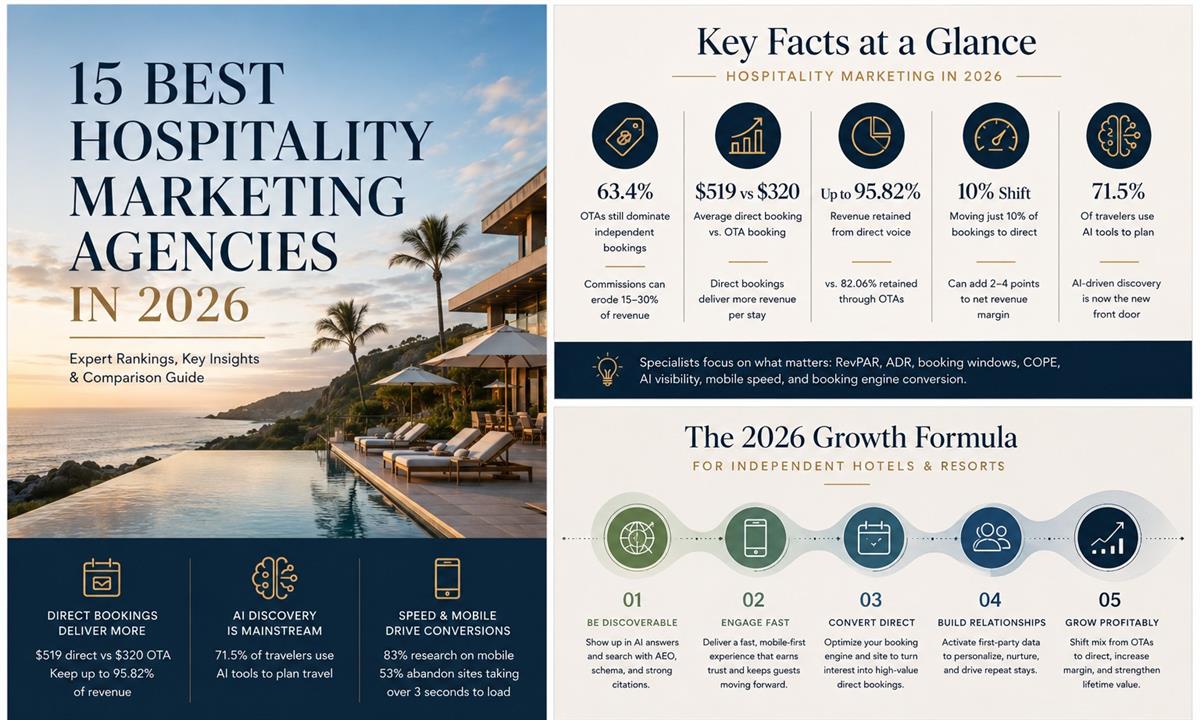
15 Best Hospitality Marketing Agencies
Aug 20, 2026
This expert guide ranks 15 leading agencies against criteria that matter in 2026: OTA displacement, Answer Engine Optimization for AI, mobile UX speed, and first-party data activation. You will find a quick comparison table, an evaluation framework you can reuse in RFPs, and balanced profiles including strengths, tradeoffs, and ideal fit. A disclosure is included where relevant so you can assess with full transparency.
Key Takeaways
- Direct bookings are higher value and higher margin. Average direct transactions are $519 versus $320 via OTAs, and hotels retain 94.87% on brand.com versus 82.06% through OTAs Hooray Lab Hooray Lab
- AI discovery is now mainstream. 71.5% of consumers use AI tools for travel search, so Answer Engine Optimization and citation ownership are critical Hooray Lab
- Speed and mobile decide conversions. 83% research on mobile, 75% of bookings follow mobile-first paths, and 53% abandon sites taking over 3 seconds to load Hooray Lab
Key Facts at a Glance (Updated August 2026)
OTAs still dominate independent bookings at an estimated 63.4%, and commissions can erode 15 to 30% of revenue. Shifting mix to direct channels matters because average direct bookings are $519 versus $320 via OTAs Hooray Lab.
Direct channels also retain more revenue. Hotels keep roughly 95.82% from direct voice and 94.87% from brand.com compared with 82.06% through OTAs Hooray Lab. Moving just 10% of bookings to direct can add 2 to 4 points to net revenue margin Hooray Lab.
What changed in 2026
AI moved from novelty to the front door of discovery. 71.5% of travelers now use AI tools to plan, and AI agents assemble a short consideration set using persistent profiles. AI-referred traffic currently accounts for 1% of hotel visits and is growing, with more than 50% growth within weeks after outbound links expanded. These AI visitors arrive pre-qualified and are commission-free, making AEO and citation ownership a revenue imperative.
Why specialists beat generalists
Hospitality specialists build around RevPAR, ADR, booking windows, and COPE, not vanity metrics. They prioritize Schema.org, GEO, mobile speed, and booking engine CRO where 80 to 85% of carts otherwise abandon Hooray Lab. AI chatbots that resolve up to 87% of routine inquiries with up to 380% first-year ROI further compress costs and lift conversion Hooray Lab.
The Cheat Sheet: Quick Agency Comparison
Most leading hospitality marketing agencies operate within a typical retainer range of $5k-$20k+ per month, depending on scope and property size.
TL;DR on five leaders:
- Hooray Agency: Best for independent luxury and lifestyle brands that want AI visibility plus measurable OTA displacement
- Cendyn: Best for enterprise CRM and global tech integration with massive multi-property data
- Thrive Internet Marketing Agency: Best for reputation recovery and GEO-informed SEO at scale
- Tambourine: Best for automated marketing systems with in-house creative production
- Milestone Inc.: Best for advanced SEO and AI-first content operations
Side-by-side snapshot
| Agency | Best for | Key strength | Ideal client size |
|---|---|---|---|
| Hooray Agency | Independent luxury, lifestyle, resorts | First-party data activation plus AEO visibility with proprietary platforms | Single asset to small groups |
| Cendyn | Enterprise chains, global brands | Enterprise CRM and tech integration powering $20B+ hotel revenue annually | Multi-property, enterprise |
| Thrive Internet Marketing | Reputation-forward growth | Review volume and sentiment lifts tied to bookings | Midscale to large portfolios |
| Tambourine | Systematized marketing ops | Automated marketing systems with in-house production | Upper-midscale to enterprise |
| Milestone Inc. | Technical SEO and AI content | AI-first SEO and structured content programs | Any size, tech-forward teams |
Quick decision cues:
- Luxury vs midscale: pick a partner fluent in rate integrity and brand aura for luxury; midscale gains most from CRO and metasearch.
- Independent vs chain: independents benefit from agile AEO and first-party data capture; chains lean on enterprise CRM and loyalty sync.
- Acquisition vs retention: acquisition relies on GEO, metasearch, and paid media; retention leverages owned data, lifecycle email, and chatbots.
How did we evaluate these hospitality marketing agencies?
Our scoring mirrors where profit is won in 2026. We weight AI visibility heavily, prioritize OTA displacement, and require transparent COPE reporting. Agencies must show how they lower CAC while protecting ADR and lifting RevPAR.
Four pillars guided rankings: 1) Direct Booking Acceleration and OTA Mitigation, 2) AI-Driven AEO with Schema.org and structured content, 3) UX and CRO to reduce 80 to 85% booking engine abandonment Hooray Lab, 4) Transparency in Measurement using COPE and Profit-Oriented Bidding concepts.
We also validated mobile speed and UX since 53% of users quit after 3 seconds, and 75% of bookings follow mobile-first journeys Hooray Lab. For AI search, we looked for Answer Engine Optimization, FAQ frameworks, and editorial content that earns first-party citations.
What we measured in AI
Visibility is not ownership. We assess whether an agency can convert mentions into citations using owned content. Our AI visibility platform analyzes around 200 real-world travel prompts per property to identify gaps, and we have seen well-executed blogs increase direct AI citations five fold. Strong FAQs win operational queries, while editorial content expands discovery.
Top 15 Hospitality Marketing Agencies (Ranked)
Disclosure: Hooray Agency is our firm. We include it here with full transparency so you can compare methods, technology, and outcomes objectively.
1) Hooray Agency — Data-Driven Direct Booking Strategy and AI-Powered SEO
- Best known for: First-party data activation with Catalyst plus AI visibility with Momentum AiQ.
- Ideal client: Independent luxury and lifestyle brands that need to reduce OTA mix and control brand storytelling.
- Core services: AEO and GEO, CRO and mobile UX, email lifecycle, paid media, creative, CRM integration.
- The good stuff: Catalyst turns anonymous site visits into marketable audiences, with about 30% of visits matchable for identity resolution; Momentum AiQ monitors citations across AI systems and distinguishes mentions from credited answers; blogs have increased direct AI citations five fold; email programs have delivered 41.2% open rates and $156,999 in direct revenue from a single send for a luxury hotel Hooray Lab.
- The catch: Best value when properties commit to content plus CRO, not single-channel fixes.
2) Cendyn — Enterprise CRM and Tech Integration
- Best known for: Enterprise CRM that powers over $20B in annual hotel revenue.
- Ideal client: Multi-property brands and global chains.
- Core services: CRM, CDP, marketing automation, personalization.
- The good stuff: Deep data pipelines, loyalty integration, multi-property sophistication.
- The catch: Directionally better for enterprise roadmaps than boutique independents.
3) Thrive Internet Marketing Agency — Reputation Recovery and GEO SEO
- Best known for: Review growth and sentiment improvements that support booking lift.
- Ideal client: Brands needing reputation repair and steady SEO growth.
- Core services: Reputation management, SEO, PPC, content.
- The good stuff: OYO Hotels saw Google reviews up 81% and Booking.com 5-star reviews up 565% after Thrive’s programs Thrive.
- The catch: Broader brand storytelling may require additional creative partners.
4) Tambourine — Automated Marketing Systems with In‑House Production
- Best known for: Systematized marketing with internal creative studios.
- Ideal client: Upper-midscale to enterprise teams seeking operationalized programs.
- Core services: Web, CRM, paid media, creative production.
- The good stuff: Scalable processes, consistent execution, asset creation at speed.
- The catch: Properties seeking bespoke narrative control may prefer hybrid models.
5) Milestone Inc. — Advanced SEO and AI-First Content
- Best known for: Technical SEO and AI-structured content at scale.
- Ideal client: Tech-forward hotels needing structured content and local SEO strength.
- Core services: SEO, content, local listings, analytics.
- The good stuff: Strong schema discipline and AI-aligned content ops.
- The catch: Creative differentiation may require additional brand partners.
6) Lotus Marketing — Openings, Conversions, and Market Transitions
- Best known for: Guiding 300+ hotels and 40 brands through openings and transitions.
- Ideal client: New builds, reflags, or repositionings.
- Core services: Brand strategy, go-to-market, digital activation.
- The good stuff: Built-by-hoteliers perspective, operational alignment.
- The catch: Works best when operations and marketing leaders engage jointly.
7) Travel Media Group — Reputation and Social Management at Scale
- Best known for: Multi-property reputation monitoring and response.
- Ideal client: Regional portfolios needing consistency.
- Core services: Reviews, social, listing hygiene.
- The good stuff: Process rigor, cross-platform coverage.
- The catch: Portfolio programs may feel standardized for bespoke luxury needs.
8) TravelBoom — Metasearch and OTA Commission Reduction
- Best known for: Metasearch mastery and brand term defense.
- Ideal client: Rate-parity focused independents and groups.
- Core services: Metasearch, paid media, SEO.
- The good stuff: Channel shift focus and revenue discipline.
- The catch: Creative brand-building often needs separate partners.
9) O’Rourke Hospitality — Guest Experience Web Design
- Best known for: GX design that lifts direct website bookings, as seen with Ashore Resort.
- Ideal client: Hotels needing UX-driven CRO.
- Core services: Web, UX, SEO, paid.
- The good stuff: Research-led design for conversion.
- The catch: Enterprise data orchestration may require add-on tools.
10) Spherical — Luxury Brand Architecture and High-Touch Creative
- Best known for: Cinematic luxury storytelling that preserves rate integrity.
- Ideal client: Luxury hotels and resorts.
- Core services: Branding, websites, campaigns.
- The good stuff: Aesthetic excellence and luxury positioning.
- The catch: Performance activation may require a paired specialist.
11) MMGY Global — Full-Funnel Travel Demand Generation
- Best known for: Integrated travel marketing and research.
- Ideal client: Destinations and large hospitality portfolios.
- Core services: Strategy, creative, media, research.
- The good stuff: Scaled reach and insights.
- The catch: Boutique properties may seek more agile experimentation.
12) Screen Pilot — Hospitality-Focused Digital Performance
- Best known for: Longstanding hospitality digital programs.
- Ideal client: Hotels seeking stable performance ops.
- Core services: SEO, paid, content, CRO.
- The good stuff: Domain specialization.
- The catch: Properties needing proprietary data capture should validate tech stack.
13) Gourmet Marketing — Performance and Revenue Maximization
- Best known for: PPC and social tuned to profit.
- Ideal client: Midscale and boutique properties.
- Core services: Paid media, SEO, content.
- The good stuff: Practical channel mix and bidding.
- The catch: Enterprise CRM complexity may need partners.
14) DCI (Development Counsellors International) — Destination and Travel PR
- Best known for: Destination marketing and earned media.
- Ideal client: DMOs and resort-area coalitions.
- Core services: PR, trade, content.
- The good stuff: Top-of-funnel demand creation.
- The catch: Requires strong conversion partners to close bookings.
15) The Marketing Agency — SMB-Friendly Hospitality Services
- Best known for: Accessible programs for SMB hospitality.
- Ideal client: Small independents and inns.
- Core services: SEO, content, paid basics.
- The good stuff: Budget-accessible entry points.
- The catch: Advanced enterprise integrations may sit outside scope.
Which specialized agency category fits your property?
Luxury and lifestyle specialists, like Hooray Agency and Spherical, protect brand aura with experience-led storytelling plus CRM-backed retention, not discounting. Performance maximizers like Gourmet Marketing and TravelBoom defend brand terms and optimize metasearch for profit. Enterprise integrators such as Cendyn and Tambourine synchronize loyalty systems with localized media to scale efficiently.
When to pick a hybrid partner
Choose a hybrid when you need both narrative control and measurable displacement of OTA volume. Hooray’s Catalyst captures first-party audiences and Momentum AiQ secures citation ownership, combining profit-focused media with AI-era visibility. That mix is effective for independents that cannot afford enterprise bloat but still require sophisticated data and UX.
How to choose the right hospitality marketing agency for your property
Start with your numbers. Document RevPAR, channel mix, and COPE per channel. Set a displacement goal, for example dropping OTA share by 10 points, which can add 2 to 4 points to net margin Hooray Lab. Require mobile proof, since 53% abandon after 3 seconds and 75% of bookings are mobile-first Hooray Lab.
Questions to ask in vetting
- How will you structure Schema.org and AEO for ChatGPT and Google AI Overviews, and how do you track first-party citations in AI answers?
- Which tools capture first and zero-party data now that third-party cookies are fading, for example Catalyst-style identity resolution?
- What is your booking engine CRO plan to cut 80 to 85% abandonment? Hooray Lab
- How do you report COPE and tie spend to OTA displacement, ADR protection, and RevPAR impacts?
What do hospitality marketing agencies actually do?
Direct booking and OTA displacement: defend brand terms, optimize Google Hotel Ads, fix rate parity, and streamline booking engines where friction drives abandonment Hooray Lab. AI-powered SEO and content: align to AEO with structured FAQs and listicles that AI can cite, plus local SEO and GEO Hooray AEO Guide.
Lifecycle, paid media, and reputation
Email and automation: segment by intent and lifecycle to lift direct share. We have seen a single targeted send generate 82 reservations and $156,999 for a luxury hotel Hooray Lab. Paid media: use Profit-Oriented Bidding logic to prioritize high-margin stays. Reputation: deploy systems that improve review velocity and sentiment, supported by AI chatbots that resolve up to 87% of routine questions with up to 380% first-year ROI Hooray Lab.
Schema you should deploy: Organization, ItemList for list pages, Review for testimonials and awards, and FAQPage for operational answers that AI agents cite.
How do pricing models work in 2026?
Most full-service retainers fall in the $5,000 to $20,000+ per month range, aligned to scope and property size Hooray Lab. Independents are advised to allocate roughly 4% to 10% of gross revenue to marketing to counter OTA share Hooray Lab.
Real-world price references
Some providers publish ranges openly. Blennd notes hospitality clients investing around $4,000 to $12,000 per month for growth programs Blennd. Lure Agency lists a DIY model at $1,800 per year, a Done-With-You model from $2,500 per month, and a Done-For-You full-service model starting at $3,500 per month Lure Agency.
Project work, for example a conversion-focused website with integrated frameworks, often runs $25,000 to $75,000+ depending on scope Hooray Lab.
Case Study Spotlight: What results look like
Catalyst-driven lifecycle wins: One luxury urban hotel sent 109,398 emails with 99.3% delivery and a 41.2% open rate, generating 82 reservations and $156,999 in direct revenue from a single send Hooray Lab.
Reputation-led growth: OYO Hotels saw Google reviews increase by 81%, Booking.com reviews by 517%, and 5-star reviews by 565% after a coordinated review program, underscoring the revenue impact of sentiment and volume Thrive.
What about paid media ROAS examples?
Paid performance outcomes vary by market and parity. While many properties see strong ROAS with segmentation and metasearch, we avoid quoting figures without a published source. Focus your evaluation on COPE reporting, margin-positive mix shift, and sub-3-second mobile speeds.
Frequently asked questions about hospitality marketing agencies
How long to see results?
Technical fixes and AI chatbots can pay back within weeks. Metasearch and PPC often show shift in 30 to 90 days. Comprehensive AEO and large-scale reputation recovery usually need 3 to 6 months.
Specialist vs generalist?
Generalists often optimize for clicks, not bookings. Hospitality agencies optimize for direct, low-cost bookings and long-term OTA displacement.
Measuring ROI?
Use COPE, not vanity metrics. Track OTA-to-direct displacement, protected ADR, and net margin lift.
Luxury vs general hospitality
Luxury marketing preserves rate integrity and aura through storytelling and first-party personalization, rather than discounting. Experience pages, authority content, and structured FAQs help AI systems understand and cite your brand Hooray AEO Guide.
Can agencies reduce my OTA dependence?
Yes. Expect brand term defense on metasearch, booking engine CRO to counter 80 to 85% abandonment Hooray Lab, and first-party data activation that captures and converts high-intent travelers.
Final recommendations: selecting your hospitality marketing partner
If you are an independent luxury property, shortlist Hooray Agency for hybrid creative plus AI visibility and first-party data activation. For enterprise chains, Cendyn offers deep CRM and loyalty integration. For portfolios with acute reputation needs, consider Thrive for review volume and sentiment momentum.
Next steps: run an AEO and AI-citation audit, require sub-3-second mobile proof, validate booking engine CRO plans, and demand COPE-first reporting that ties spend to OTA displacement. When proposals rely on outdated SEO or ignore AI answers, keep looking.
How Hooray’s consultation works
We begin by mapping positioning, configuring tracking, and deploying a prompt universe that mirrors traveler queries. Within days, live dashboards baseline AI visibility and identify content, CRO, and data-capture opportunities. Engagements are flexible, from fully managed programs to self-managed optimization support.
Conclusion
Profit in 2026 comes from owning demand and owning the story. The agencies that matter reduce OTA dependency, win AI citations with structured content, and turn anonymous traffic into known guests. Use COPE to keep every tactic accountable to operating profit, not impressions.
Your next move: 1) baseline RevPAR, channel mix, and COPE; 2) audit AI answers and mobile speed; 3) demand a booking engine CRO plan and first-party data capture; 4) pick a partner whose technology fits your operation. If you want a hybrid that blends luxury storytelling with measurable displacement and AI visibility, book a Hooray Agency consultation to see your AI baseline and data-capture opportunities in days.