Hotel Branding Strategy: Build a Winning Brand in 2026
Apr 30, 2026
A winning hotel brand in 2026 is not a logo, it is a system that aligns positioning, design, operations, and digital to deliver a consistent promise guests can feel. Strong brands in hospitality outperform on revenue, with top performers achieving a 41 percent cumulative RevPAR (Revenue per Available Room) premium over weaker peers in recent years, a clear signal that brand clarity translates into financial results CBRE Hotel Brand Performance 2025.
This guide gives owners and executives a practical, measurable playbook. You will get an 8-step brand framework, implementation tactics your teams can execute, and a measurement model tying brand to RevPAR, GOPPAR (Gross Operating Profit per Available Room), and NPS (Net Promoter Score). We bring real hospitality experience to the table, from full rebrands and website builds to creative direction and CRM (Customer Relationship Management). Our mandate is simple: we are here to make you impossible to ignore.
Key Takeaways
- Brand strength pays: top brands achieved a 41 percent cumulative RevPAR premium versus bottom performers CBRE Hotel Brand Performance 2025.
- Emotional connection beats satisfaction: emotionally connected customers are more than twice as valuable Hospitality Is the Hidden Edge.
- Mobile speed drives direct revenue: a one‑second mobile delay can cut conversions by up to twenty percent Gourmet Marketing.
The Importance of Hotel Branding in 2026
Hotel branding is the discipline of defining and delivering your property’s identity across values, visuals, messaging, and guest experience. It shapes expectations before arrival and memories after checkout. In a crowded market, it is the difference between being a commodity and becoming a guest’s default choice.
Competition has never been fiercer. Major groups encompass over 450 brands representing 17.5 million rooms, while independent hotels account for 14.3 million rooms globally Hotels Magazine. In this landscape, clarity and differentiation are survival strategies.
Brand strength shows up on the P&L (Profit and Loss statement). The performance spread between top and bottom luxury brands widened to nearly seven percentage points from 2019 to 2024. The strongest brands delivered a 41 percent cumulative RevPAR premium versus 29 percent in the earlier period CBRE Hotel Brand Performance 2025.
That premium reflects pricing power, loyalty, and mix shift. Why guests choose you is as much emotional as rational. Emotionally connected customers are more than twice as valuable as highly satisfied ones, a signal that experience-led brands earn deeper loyalty and higher lifetime value Hospitality Is the Hidden Edge. Large groups have leaned into portfolio expansion and distinct brand promises, while independents win through sharp positioning and authentic local experiences.
Essential Elements of Hotel Brand Identity
Great hotel brands are built on four connected pillars that move from strategy to street level. Skip one and the promise will break in the lobby.
Positioning and UVP (Unique Value Proposition): Define who you are for, what you solve, and the value only you can deliver. In our work, we capture this in a concise framework that guides design and operations.
Visual system and standards: Color, type, photography, and environmental cues should reinforce the feeling you want guests to carry. Color psychology matters; for example, ocean-adjacent resorts often use white, soft nudes, and Mediterranean blue to cue restoration and calm, while social spaces may add warm, energetic tones for vibrancy Arcedior, Color Psychology.
Brand voice, values, and the guest promise
Voice and messaging translate strategy into words guests remember. We anchor copy in clear values and a guest promise that teams can act on. In luxury, credibility comes from consistency, restraint, and service behaviors that match the narrative, not from ornate language alone EHL Insights, Luxury Branding.
Emotional connection is the north star. Guests who feel understood and valued are more than twice as valuable over time Hospitality Is the Hidden Edge. That is why brand identity must extend into sensory details and micro-moments across the stay, not just the website and signage.
8-Step Framework for Strategic Hotel Branding
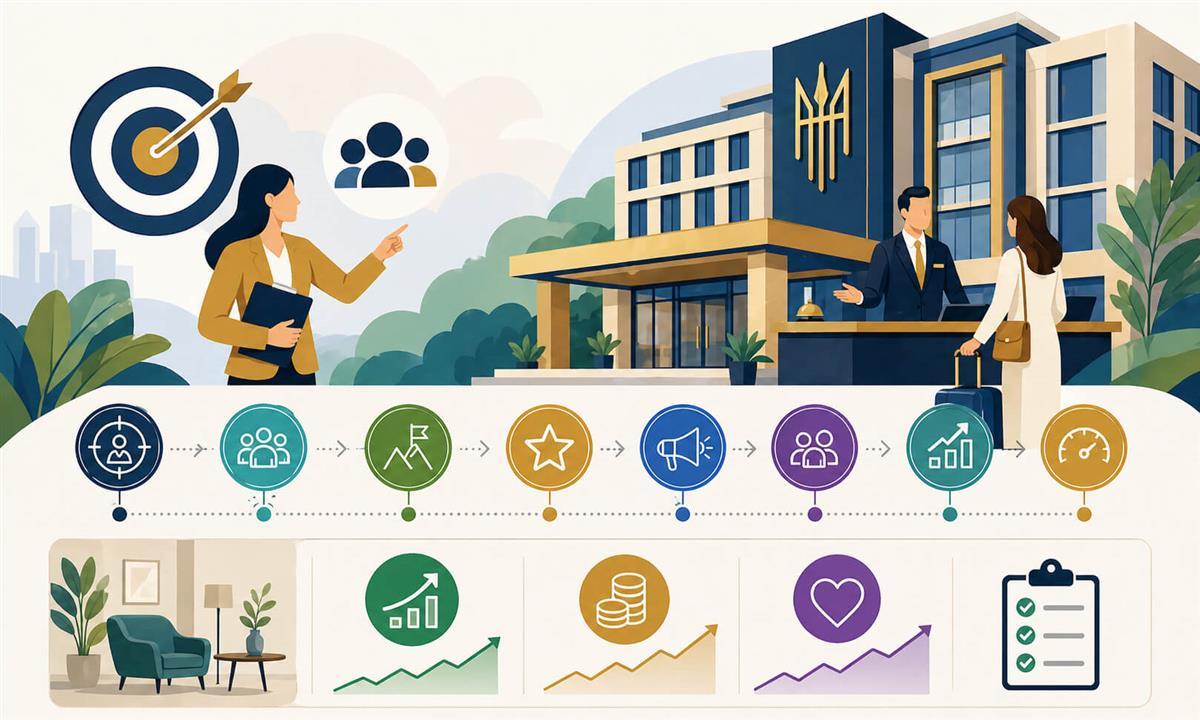
We use an 8-step framework that links insight, identity, and implementation. It creates a straight line from brand idea to daily behaviors and revenue impact.
-
Market research and competitive analysis: Map demand drivers, channel dynamics, and competitor gaps. Identify where you can credibly lead.
-
Target audience segmentation: Go beyond demographics to psychographics and occasions. Different audiences pick hotels for different reasons, from efficiency for business travelers to space and experience for families.
-
Brand architecture: If you manage multiple offerings, define how the master brand, collection, and sub-brands relate.
-
Visual identity creation: Build a flexible system that scales across web, property signage, uniforms, amenities, and content.
-
Experience design alignment: Translate values into service standards, F&B (Food & Beverage) concepts, programming, and partnerships with local artists and makers for authentic context.
-
Staff training and culture integration: Employees embody the brand. Training shapes consistency, empowers judgment, and directly lifts perceived quality TrainingHotels.
-
Digital presence optimization: Design mobile-first, map journeys, and deploy CRM (Customer Relationship Management) to recognize, reward, and personalize across channels.
-
Launch and market introduction: Stage the rollout across owned, earned, and paid media, align revenue management, and prepare for sprint cycles to refine after go-live.
How we apply it in practice
Our touchpoint ecosystem covers:
- Positioning
- Name
- Logo
- Essence
- Visual approach
- Environmental design
- On-property activations
- Employee and customer campaigns
- Social
- Online media
- CRM (Customer Relationship Management)
- Storytelling
We pair this with creative direction and website builds to ensure the brand reads the same online and on property. Targeting is grounded in psychographics, demographics, geography, and journey stage to nurture engagement, booking, and loyalty. Or as we say, we are here to make you impossible to ignore.
Implementing an Effective Hotel Brand
Implementation succeeds when the promise fits the property, the market, and the team. Align ambition with operational realities, then move in coordinated waves.
Franchise vs independent: The choice hinges on distribution, standards, fees, and the match between your asset and a flag’s positioning. Use directional benchmarks and scenario models to weigh topline lift against costs and constraints.
Rebrands resonate when properties add biophilic elements like hanging gardens, eliminate single-use plastics, and embed wellness as a core, not a package add-on DLR Group, 2026 Trends.
Technology, culture, and local partnerships
Technology underpins consistency. Use brand kits in your CMS (Content Management System), templated email modules, and DAMs (Digital Asset Management systems) to control assets. CRM (Customer Relationship Management) and PMS (Property Management System) data can drive tailored recognition and rewards across stay occasions.
Culture is the delivery system. Train teams to personalize within guidelines, not to recite scripts. Partner locally to root the brand in place, from artists and musicians to cultural institutions that enrich the guest itinerary TrainingHotels, Local Partnerships. Younger demographics are especially attuned to authentic sustainability and community engagement, so transparency matters.
Optimizing Digital Brand Presence to Enhance the Guest Experience
Digital is often the first lobby. It must communicate feeling fast, then make booking frictionless. This reduces dependence on intermediaries and protects margin.
Start with mobile. One second of extra mobile load time can cut conversions by up to twenty percent, so performance is brand-critical Gourmet Marketing. OTA (Online Travel Agency) commissions can reach up to twenty percent per reservation, which makes optimizing direct booking economics a strategic imperative Gourmet Marketing.
Consistency, social proof, and personalization
Keep brand voice and visuals consistent across site, email, and social. Use short-form video for room walkthroughs and neighborhood guides to set expectations and reduce uncertainty. Curate and repost guest content and reviews as social proof to increase trust dailypoint, Social Media Tips.
Map the guest journey from dream to stay to return. Personalize recommendations and content by segment and intent. As we put it, putting mobile first is critical, but with a clear understanding that many other touches will also drive critical results.
Measuring Hotel Brand Success and ROI
Treat brand as an operating system and measure it like one. Blend revenue, profit, and guest sentiment to see the full picture, then iterate.
Financial performance: Track Occupancy, Average Daily Rate (ADR), Revenue per Available Room (RevPAR), and Revenue per Occupied Room (RevPOR) for topline discipline AltexSoft, Hotel Metrics. Add Gross Operating Profit per Available Room (GOPPAR) to understand true efficiency and how brand lifts profitability, not just price.
Brand health and experience indicators
Monitor Net Promoter Score (NPS) to gauge satisfaction and referral likelihood, a leading indicator of repeat and word-of-mouth Cloudbeds, Hotel NPS. Layer in review scores and share of positive sentiment for your core attributes.
Operational drivers: Track staff training completion, turnover, and qualitative feedback. Well-trained teams deliver the brand more consistently, which shows up in sentiment and rate strength TrainingHotels. Tie initiatives to A/B-tested outcomes, like uplift in direct booking share after a mobile speed sprint.
Avoiding Common Hotel Branding Mistakes
Common pitfalls are avoidable with the right operating rhythm. The biggest gap is promise without proof, a brand that reads well online but feels generic on site.
Inconsistent application: Assets drift across channels, on-property cues clash with digital tone, and the narrative breaks. Fix it with clear standards, governance, and periodic audits.
Neglecting staff: Scripts and rigidity stifle authentic service. Train for judgment and empowerment so teams can deliver moments that match your values EHL Insights, Luxury Branding.
Ignoring place and not measuring impact
Brands that overlook local culture and partnerships miss easy ways to create memory and meaning. Map community collaborations into the programming calendar.
Failing to measure: Without KPIs, teams chase aesthetics, not outcomes. Connect campaigns to metrics like RevPAR mix shift, direct share, NPS, and GOPPAR. Experience maps help translate brand into repeatable moments that guests notice and talk about FINE, Guest Experience Mapping.
Trends Shaping the Future of Hotel Branding
Three forces will define brand advantage: personalization, wellness, and sustainability, all delivered with credibility and speed.
Personalization at scale: Predictive AI is pushing hospitality from generic touches to relevance in every channel, making personalization a performance requirement rather than a nice-to-have DLR Group, 2026 Trends.
Wellness and sustainability move from features to foundations
Wellness-focused personalization is rising, from sleep optimization programs to individualized fitness and tailored spa services. Rooms are being engineered for restorative sleep, with micro-zones for personal routines DLR Group, 2026 Trends.
Sustainability has shifted from marketing tactic to mandate. Travelers, especially younger segments, expect transparency and integration into the stay. Design choices, operations, and partnerships should reflect this, not just amenity swaps. Thoughtful brand systems that show progress over perfection will earn trust dennis.studio, 2025 Trends.
Frequently Asked Questions
How does hotel branding impact RevPAR?
Hotel branding directly impacts RevPAR (Revenue per Available Room) by enabling stronger pricing power, higher occupancy, and improved guest loyalty. Top-performing brands have achieved a 41 percent cumulative RevPAR premium over weaker competitors, demonstrating that clear, consistent branding translates into measurable financial results CBRE Hotel Brand Performance 2025.
What is the difference between franchise and independent hotel branding?
Franchise hotel branding offers established distribution, standardized systems, and brand recognition, but comes with fees and less flexibility. Independent hotel branding allows for unique positioning, tailored guest experiences, and local partnerships, but requires more effort in building awareness and managing operations.
Why is emotional connection more valuable than guest satisfaction?
Emotionally connected guests are more than twice as valuable as those who are simply satisfied. Emotional connection drives deeper loyalty, increased repeat business, and higher lifetime value, making it a critical focus for hotels seeking to outperform on revenue and guest retention Hospitality Is the Hidden Edge.
How can hotels optimize their digital presence for direct bookings?
Hotels should prioritize mobile-first website design, ensure fast load times, and maintain consistent brand voice and visuals across all digital channels. Optimizing for direct bookings reduces reliance on OTAs (Online Travel Agencies) and protects margins, as OTA commissions can reach up to twenty percent per reservation Gourmet Marketing.
Conclusion
Brand is an operating strategy, not a paint job. In saturated markets, the hotels that win define a clear promise, design for emotion, and deliver it consistently across people, product, and pixels. The financial upside is real, with brand strength linked to RevPAR premiums and healthier profit mix, while guest-centric metrics like NPS keep you honest about experience quality.
If you are planning a new flag, repositioning an existing asset, or pushing for more direct revenue, we can help. Our team integrates strategy, creative, web, and CRM (Customer Relationship Management) to connect technology and people in service of performance. Let’s build a brand your guests feel, your teams can deliver, and your balance sheet will love.
References
- Hotel Brand Performance 2025
- Crowded house: The forces and needs behind hotel brand differentiation
- Hospitality Is the Hidden Edge: Why Emotional Connection Drives Customer Loyalty
- Hotel Website Conversion Optimization
- RevPAR, Occupancy Rate, ADR and Other Hotel Metrics
- Hotel NPS: How to Measure Guest Satisfaction
- Shaping Brand Experience: The Impact of Employee Training on Hotel Branding
- Local Partnerships in Hotels: Enhancing Guest Experience
- Impact of Color Psychology in Hospitality Design
- Luxury Branding in Hospitality
- Mapping Hotel Guest Experience to Deliver Extraordinary Brand Experiences
- 2026 Hospitality Design Trends
- Five Hotel Branding Trends for 2025
- Smart Social Media Marketing Tips for Hotels