How to Launch a Hotel Digital Marketing Strategy in 2026
Apr 30, 2026
Most hotel bookings start online, so your revenue hinges on a connected plan that wins search, converts on mobile, and nurtures guests across channels. Hotels with integrated strategies see higher direct booking rates, while omnichannel consistency reduces friction and lifts performance (HotelTechReport, SiteMinder). This how-to walks you through goals, website fixes, SEO, paid media, social, email, reviews, analytics, and optimization.
You will get a precise, stepwise playbook tailored to US independents and boutique properties. We pair creative excellence with technology so you can reduce OTA reliance, improve mobile conversion, and scale direct revenue. Follow the five steps, use the checklists, and apply the benchmarks to plan budgets, prioritize quick wins, and sequence long-term growth initiatives.
Key Takeaways
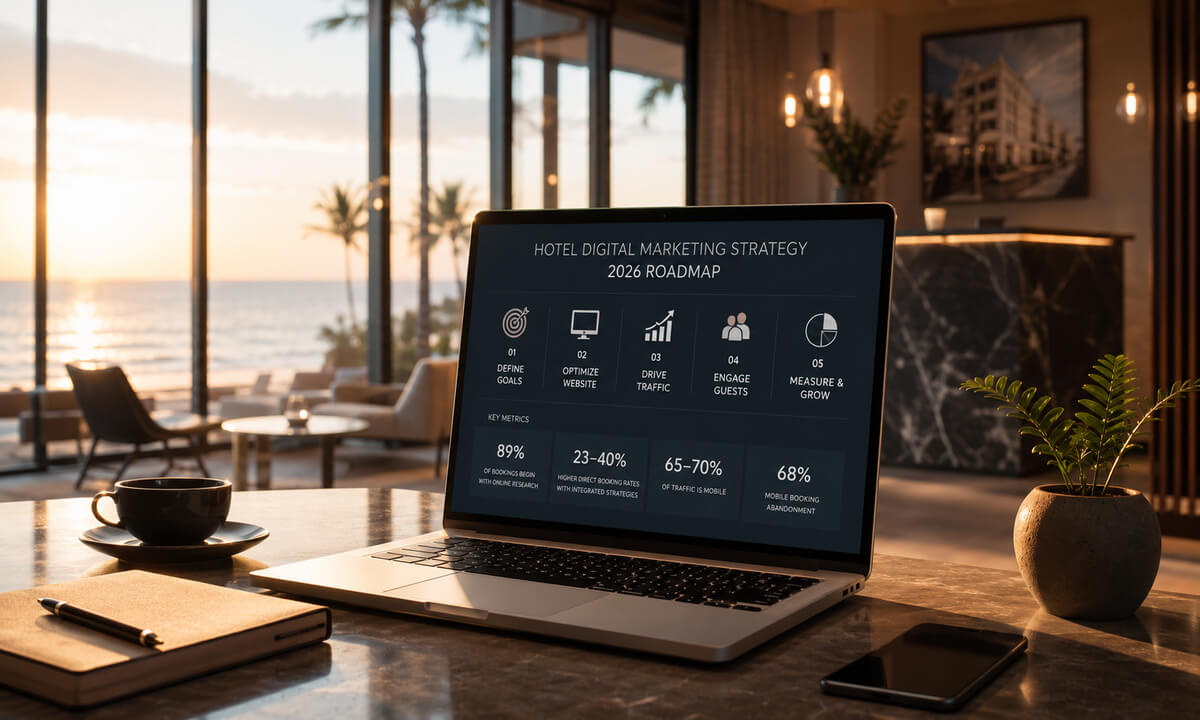
- 89% of hotel bookings begin with online research, so discovery and reputation hygiene are non negotiable (HotelTechReport).
- Integrated digital strategies correlate with 23-40% higher direct booking rates and about 35% lower guest friction when messaging is consistent across channels (SiteMinder).
- Mobile dominates traffic at 65-70%, yet mobile booking abandonment is 68%. Fixing mobile UX and checkout flow is a top revenue lever (Swiss Education Group, Little Hotelier).
Prerequisites and Expected Outcomes
Prerequisites:
- Access to your CMS, booking engine, GA4, Google Business Profile, ad accounts, and email platform.
- Current rate plans and packages aligned with revenue goals.
- At least 2 months of performance data from site, paid media, and OTAs.
Expected outcomes after 90-120 days:
- A measurable plan tied to direct revenue and channel mix targets.
- Faster mobile experience and simpler checkout that reduce abandonment.
- Always-on local SEO, Hotel Ads, and email journeys that compound results.
Troubleshooting tips:
- If traffic grows but bookings do not, audit mobile UX and checkout steps first. High abandonment is often a flow problem, not a demand problem.
Step 1: Define Your Hotel’s Marketing Goals and Target Audience
Anchor goals to revenue and mix. Many US independents aim for a 35-50% direct booking share to limit OTA (Online Travel Agency) commissions, which range widely in the market.
Create quarterly targets for direct bookings, brand visibility, guest loyalty, and revenue per available room. Hotels with comprehensive strategies report 23-40% higher direct booking rates, so integration is your lever for scale (SiteMinder).
Build personas from your PMS (Property Management System) and web analytics. Segment Business Travelers, Leisure Couples, Families, and Groups. Industry snapshots show Business Travelers as a large share of bookings, followed by Leisure Couples and Families.
Map each persona to needs, dates, and channels. For example, travelers under 35 are heavy social researchers, with 72% checking social media before booking. Short-form video and social proof matter for that audience (Gourmet Marketing).
Quantify acquisition efficiency. Track Customer Acquisition Cost by channel. Industry ranges can vary significantly by market and star class, so benchmark CAC directionally, then refine with your data over 30-60 days.
Use long-tail queries like “hotels in [city] near [attraction]” to capture higher intent at lower CPCs. Tie every objective to a metric and timeframe. For example, move direct mix from a current baseline to a higher target over 2 quarters, or lift repeat bookings via lifecycle email.
How to set revenue-tied objectives
Start with last year’s revenue by channel. Set a direct revenue target and a direct mix target for the next two quarters. Layer in supporting KPIs: site conversion rate, mobile abandonment, cost per booking, and review volume. Because 89% of bookings begin with online research, include search visibility and reputation as leading indicators (HotelTechReport). Define success criteria per persona, such as corporate weekday occupancy for Business Travelers, or weekend package uptake for Leisure Couples. Document risks and countermeasures, like weather seasonality or event calendars, and align paid budgets to shoulder periods.
Step 2: Optimize Your Hotel Website for Conversions
Prioritize mobile experience. Mobile drives 65-70% of hotel website traffic, so speed, clarity, and thumb-friendly navigation come first (Swiss Education Group). Yet mobile abandonment is 68% compared to 45% on desktop, often due to too many steps in the booking engine (Little Hotelier). Aim for under 2 second load times and a 4-6% mobile conversion rate, then pressure test with real devices.
Streamline the path to book. Use a single, prominent Book Now CTA, persistent dates and guest selector, and a 1-page checkout. Autofill address and card fields to reduce friction. Properties that consolidate steps and enable autofill cut abandonment by 10-15%. Feature real rooms, rates, and trust signals. Since 72% of bookers check reviews before reserving, surface ratings and recent quotes near CTAs (HotelTechReport).
Lock in local SEO fundamentals. Keep your Name, Address, and Phone consistent. Fully complete your Google Business Profile with categories, amenities, photos, and Q&A. Add schema markup for Hotel, Room, and FAQ where applicable. Maintain fresh content for events and neighborhoods to capture high intent discovery and map results.
Mobile UX checklist for fewer abandons
- Lighthouse score and Core Web Vitals within green ranges on mobile.
- Clear rate comparison and inclusions above the fold.
- Apple Pay and Google Pay support where your processor allows.
- Inline validation for forms and error copy that explains fixes.
- Accessible color contrast and 16 px minimum font sizes.
- Guest reassurance: cancellation policy, parking, Wi-Fi, and pet info near CTAs.
- 1-page checkout with autofill and minimal required fields.
If bounce is high on room detail pages, compress media, simplify rate names, and add a sticky Book Now bar on scroll.
Troubleshooting common conversion blockers
If add-to-cart is strong but checkout lags, remove optional fields, enable guest checkout, and defer account creation. If mobile traffic is high but scroll depth is low, improve above-the-fold messaging and reduce hero height. If trust is the issue, add recent review snippets and security badges near payment. Keep testing. Small UX fixes compound, particularly with mobile-first traffic share at 65-70% (Swiss Education Group).
Step 3: Execute Core Digital Marketing Tactics
Cover demand capture, demand generation, and loyalty in one plan.
For intent capture, optimize local SEO and metasearch. 76% of mobile searches have local intent, so a complete Google Business Profile with fresh photos, posts, and offers is critical (Digital Agency Network). For paid, Google Hotel Ads commonly return a 3:1 to 5:1 ROAS (Return on Ad Spend) when rates and availability feed accurately from your hotel center integration (ROI300).
For demand generation, build content that answers traveler questions. Long-form city and neighborhood guides in the 5,000 to 10,000 word range can capture a meaningful share of organic traffic over time. Pair with seasonal stories, itineraries, and dining lists.
On social, reach younger researchers with short-form video and authentic visuals. 72% of travelers under 35 check social before booking, so social proof and creator content matter (Gourmet Marketing). User generated content drives stronger engagement than brand creative and sees multiples higher engagement.
Nurture and retain with lifecycle email. Personalized emails lift click through rates by 15-25% (Everbold Marketing). Abandoned booking recovery emails recapture 30-40% of near-bookings within 48 hours when you send a helpful reminder and bring the cart back in one click (Travel Media Group). After departure, a thank you email with a subtle room upgrade or member rate offer drives a notable return visit uplift.
Paid and metasearch campaigns that convert
- Google Search and Performance Max for brand, competitor defense, and high-intent non brand.
- Google Hotel Ads with live rates and availability for price parity and direct booking preference. Typical ROAS ranges from 3:1 to 5:1 when well managed (ROI300).
- Structure campaigns by intent and device, then set mobile bid adjustments. Use location extensions and callouts for parking, breakfast, and pet friendly terms.
- Sync promos with revenue management. Dynamic pricing alerts on last minute inventory can lift revenue in tight windows.
- Measure beyond clicks. Track cost per booking and profit per booking, not just CPA.
Content, social, and email that sustain demand
- Editorial calendar: monthly city guide updates, biweekly blogs on events, weekly reels of rooms and neighborhood spots.
- Templates: 1 itinerary, 1 FAQ, 1 event roundup per month. Repurpose to email and social.
- UGC workflow: request rights to guest photos and videos, tag creators, and credit in captions. UGC drives stronger engagement than brand-only posts.
- Email journeys: welcome series, browse and cart abandon, pre arrival upsells, post stay review request and loyalty invite. Personalized emails show 15-25% CTR lifts on average (Everbold Marketing).
- Review responses: acknowledge, apologize if needed, state the fix, and invite a return. Polite, prompt replies build trust for the 72% who check reviews before booking (HotelTechReport).
Step 4: Track Performance with Analytics & Adjust
Implement measurement before scaling spend. In GA4, set conversion events for completed bookings, call clicks, contact form submits, and email signups. Connect Google Search Console to monitor index health and queries. Add pixels for Meta and other paid channels. Use session recording tools to see where guests hesitate and drop.
- Tier 1 KPIs: direct booking rate with a target of 35-50%, cost per booking, and revenue per available room (RevPAR).
- Tier 2 KPIs: site conversion rate, mobile abandonment, and share of voice on key queries.
Hotels that operate omnichannel with consistent messaging see about a 35% reduction in guest friction, which improves the whole funnel (SiteMinder).
Run A/B tests continuously. Expect incremental gains, in the 5-15% range per quarter across ads and UX when you test headlines, imagery, CTAs, and checkout steps. Reallocate 20-30% of budgets monthly toward the best performing campaigns or audiences. Hold a weekly review of traffic, bookings, revenue, and sentiment. If spend rises faster than revenue, pause lower intent keywords, tighten geo, and test offer framing before adding budget.
Set up measurement the right way
- GA4: enable enhanced measurement, define booking conversion with transaction value, and map source channel to revenue.
- Google Business Profile: monitor calls, messages, and direction requests for local intent.
- UTM hygiene: standardize campaign, source, medium, and content naming so you can compare channels.
- Dashboard: a single view of direct bookings, CAC, ROAS, review volume, and sentiment. Review against your weekly pacing targets.
A/B testing cadence and budget shifts
- Test one change per variant to get clean reads. Run for at least one full booking cycle.
- Prioritize high impact zones, room detail pages, rate cards, and checkout. Small copy and layout changes drive real gains.
- Shift 20-30% of monthly budget toward top performers. Keep a 10% innovation budget for new audiences and creatives.
- Document learnings. The compounding effect of steady testing is significant over quarters.
Step 5: Avoid Common Digital Marketing Mistakes
Over reliance on OTAs (Online Travel Agencies) is expensive. Many hotels lean heavily on intermediaries and absorb commission ranges that erode margin. Set a direct mix target and fund the channels that move it. Poor mobile UX is another common leak. With mobile abandonment at 68%, long forms and multi step checkout cost real revenue (Little Hotelier).
Neglecting local SEO means missing a large share of high intent discovery, as 76% of mobile searches have local intent (Digital Agency Network). Inconsistent messaging across channels creates friction. Omnichannel consistency can reduce friction by about 35% and support conversion lifts (SiteMinder). Finally, many properties lack full-funnel tracking, which makes budget optimization guesswork.
Checklist to close gaps fast
- Direct mix: set a quarterly target, baseline by channel, and fund brand search, Hotel Ads, email, and SEO.
- Mobile UX: compress images, improve above-the-fold clarity, add sticky CTAs, and move to a 1-page checkout with autofill.
- Local SEO: complete your Google Business Profile, post weekly, answer Q&A, and add local schema.
- Social proof: publish recent reviews and UGC in key pages and emails. 72% of bookers check reviews before reserving (HotelTechReport).
- Measurement: define conversions in GA4, standardize UTMs, and review CAC and ROAS weekly.
How Hooray Agency helps close these gaps
Hooray integrates strategy, technology, and creative in one workflow. Our teams align revenue goals with media, SEO, content, and in-house production so your message and metrics match across channels. We deploy proven playbooks, mobile-first UX fixes, Hotel Ads setup, local content systems, and lifecycle email. The result is clarity on spend, fewer leaks in the funnel, and momentum toward your direct booking targets.
FAQ: Your Top 2026 Hotel Digital Marketing Questions Answered
Quick answers to help you budget and prioritize the highest return tactics for US independents and boutiques.
What should my 2026 digital marketing budget be?
Industry guidance recommends 5-8% of total revenue for hotel digital marketing (HITEC). For a mid range hotel, this translates to 80,000 to 130,000 dollars per year. A common split is 35-40% to paid search and metasearch, 20-25% to social ads and creators, 15-20% to SEO and content, and 10-13% to email and tools. Adjust by season and channel performance.
Which tactics deliver the best ROI for small and independent hotels?
For demand capture, Google Hotel Ads return a 3:1 to 5:1 ROAS (Return on Ad Spend) when rates and availability are accurate (ROI300). For nurturing, abandoned booking recovery emails reclaim 30-40% of near bookings within 48 hours with helpful reminders and 1 click return to cart (Travel Media Group). Pair both with a fast mobile site to reduce the 68% mobile abandonment rate (Little Hotelier).
How does Hooray Agency stay ahead of digital trends?
We combine ongoing channel testing, revenue aligned creative, and platform native production to keep pace with guest behavior. Our approach blends human insight with technology so you can adopt proven tactics early, retire underperformers quickly, and move budget toward what works without risking brand integrity.
Conclusion
Your 2026 hotel marketing plan wins when it connects discovery, decision, and loyalty with one integrated workflow. Start by setting revenue tied goals and building personas. Fix mobile UX and checkout to capture more of your existing demand. Run Hotel Ads and high intent search, invest in local SEO and long form city guides, and nurture with personalized email. Measure everything, test weekly, and shift budget toward winners. With 89% of bookings starting online and omnichannel consistency reducing friction by about 35% (HotelTechReport, SiteMinder), the upside is clear. If you want a partner to align strategy, tech, and creative while producing content and video in house, Hooray Agency is built for it. Let’s map your 90 day plan and move your direct mix in the right direction.
References
- HotelTechReport - Hotel Digital Marketing
- SiteMinder - Digital marketing for hotels
- Swiss Education Group - Hotel Digital Marketing
- Little Hotelier - Hotel digital marketing guide
- Gourmet Marketing - 2026 Hotel Marketing Trends
- Digital Agency Network - Hotel Marketing Campaigns
- ROI300 - Hotel Digital Marketing Strategies
- Everbold Marketing - Hotel Digital Marketing
- Travel Media Group - Hotel Digital Marketing 2025
- HITEC - How much should hoteliers be spending on marketing?