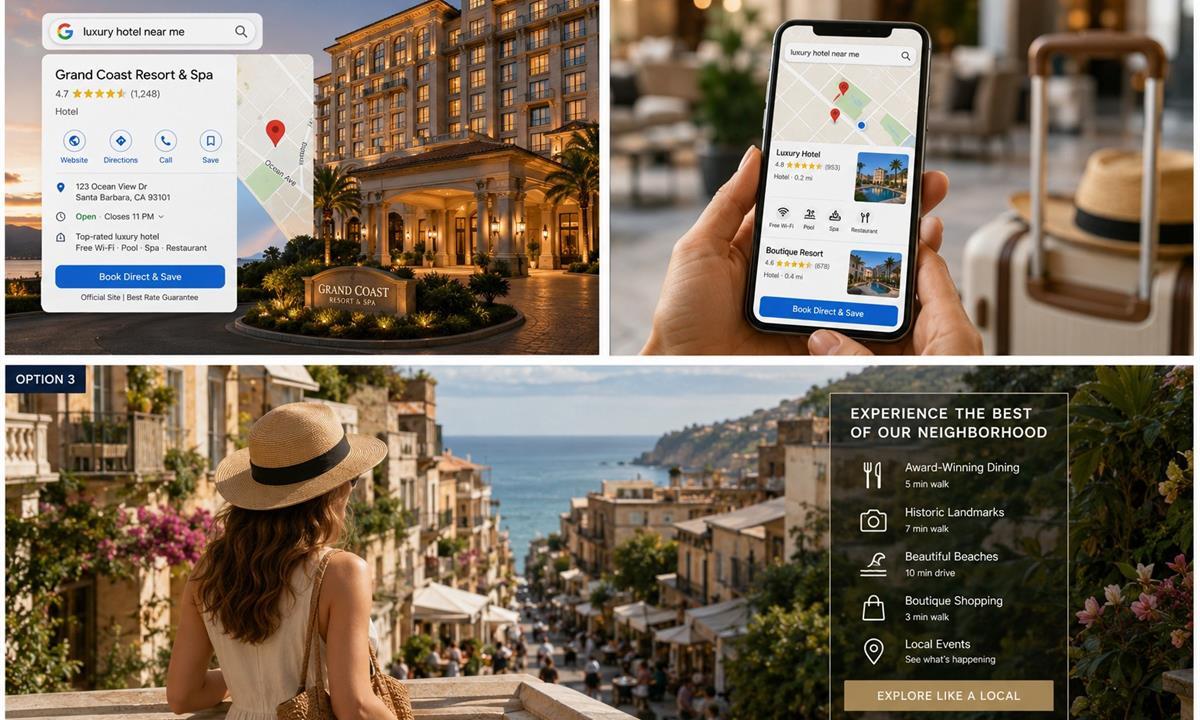
Local SEO for Luxury Hotels
Jun 16, 2026
Local SEO for Luxury Hotels: Step-by-Step Strategy
to Win Direct
Local SEO for hotels is the practice of optimizing your website, Google Business Profile, reviews, and local content so you appear for location-based searches and convert nearby travelers into direct bookings. It focuses on hyperlocal, high-intent queries, your Map Pack presence, and the signals AI assistants use to cite you as the source.
Why this matters now: Google commands close to nine in ten searches, and the Local Map Pack captures 42% of clicks. Winning locally lets you shift bookings away from high-commission OTAs to your direct engine, where net revenue per room is materially higher. This step-by-step guide shows US luxury hotels exactly how to do it, backed by field results, AI search insights, and proven tactics you can deploy this quarter.
Key Takeaways
- The Local Map Pack is prime real estate, capturing 42% of local result clicks, so GBP optimization is non-negotiable Hotel SEO Guide: Google Business Profile.
- Direct bookings typically generate 62% higher net revenue per room than OTA reservations, making Local SEO a high-ROI lever Hotel Marketing Statistics.
- Completing 100% of your Google Business Profile fields can yield up to 7x more clicks, and uploading 10+ quality photos increases direction requests by 42% Attract More Visitors to Google Business Profile Optimizing GBP for Hotels.
What Is Local SEO for Hotels?
Local SEO for hotels means optimizing your digital presence for location-based searches so nearby travelers can find, evaluate, and book your property. It centers on your Google Business Profile, localized site content, accurate listings, and strong reviews that feed both Google and AI assistants.
Why it is different from general SEO: the battle is decided in the Map Pack and on Maps, where users compare amenities, photos, and reviews at a glance. The Map Pack alone captures 42% of local clicks, so hotels that master it gain a compounding advantage Hotel SEO Guide: Google Business Profile. With Google owning roughly 88 to 90 percent of search, optimizing for Google’s local ecosystem is the most leveraged move you can make Local SEO for Hotels.
Why Does Local SEO Matter for Hotels and Resorts?
Local SEO drives high-intent traffic to your direct booking engine and reduces dependence on costly intermediaries. OTA commission fees commonly range from 15% to 30% per booking, while direct bookings generate 62% higher net revenue per room, improving margins without adding inventory Hotel Marketing Statistics.
Mobile and reputation amplify the effect. About 60% of hotel bookings occur on mobile devices, and 81% of travelers read reviews before booking, which makes GBP accuracy, fast mobile UX, and proactive review management crucial Hotel Marketing Statistics. Properties that invest in local visibility and reputation see tangible wins. We have seen boutique and resort clients dominate the Map Pack and increase organic clicks by triple and even quadruple digits when they fully execute local SEO and performance content.
Integrating Local SEO with Digital Marketing
Use an integrated plan that pairs Local SEO with paid media, social, email, and direct booking incentives. Start with a search-ready site and an active Google Business Profile, then layer channel tactics that move guests from discovery to booking.
Why integrate now: 80% of search users rely on instant, AI-generated answers for a significant share of queries. Hotels must optimize to be cited by AI, not just ranked as a blue link SEO and AEO. Email rebooking campaigns can drive about 18% of repeat direct bookings and deliver an estimated 36 to 38x ROI, making owned email a powerful counterweight to OTA costs Hotel Marketing Statistics.
What works in practice:
- Local SEO and content: publish neighborhood and experience guides, plus structured FAQs guests ask most. Our analysis found blogs increase the likelihood of being directly cited by AI fivefold, while robust FAQs win operational queries. Condado Vanderbilt’s blog strategy achieved 79.6% LLM visibility, and Hotel Bennett’s basic FAQ achieved 75.9%.
- Social: showcase short-form, mobile-first visuals that mirror the stay. Use Reels and UGC (User-Generated Content) to drive branded search and email capture.
- Email and retention: deploy browse abandonment, pre-arrival upsells, and post-stay review requests. Our Catalyst campaigns have produced outcomes like 109,398 emails sent at 41.2% open rate and $156,999 in revenue for a luxury urban hotel.
- Paid search and meta: bid on brand and unbranded local terms while your organic footprint ramps. Use direct booking benefits in ad copy.
Step-by-Step: Implementing Local SEO for Hotels
Set up and optimize your Google Business Profile
- Complete every field, select precise categories, add attributes like amenities, sustainability, and accessibility. Fully completed profiles can see up to 7x more clicks Attract More Visitors to Google Business Profile.
- Upload 10+ high-quality photos. Profiles with this volume get 42% more directions requests and 35% more website clicks Optimizing GBP for Hotels.
- Post weekly offers and events, keep hours and descriptions current.
Optimize on-page hotel SEO
- Create location pages with geo-modifiers and internal links to rooms, dining, spa, and events.
- Add FAQ sections that answer booking, parking, pet, and fee questions. Mark up with FAQ schema to help AI and Google parse answers.
- Embed a fast, accessible map, and highlight proximity to top attractions.
Manage and encourage guest reviews
- Ask every guest for a review via email and SMS. Respond to all reviews, positive or negative. A 1-point reputation score increase can justify up to an 11.2% rate lift without sacrificing occupancy How to Improve Hotel Reviews and Boost Bookings. A 1% reputation gain can raise RevPAR (Revenue Per Available Room) by about 1.42% Guest Reviews and Feedback.
Build local citations and listings
- Ensure consistent Name, Address, and Phone across TripAdvisor, Yelp, Apple Maps, local tourism boards, and meeting sites. Consistency reduces algorithmic confusion that can hurt Map Pack performance Local SEO Guide.
- Monitor and update seasonal amenities, fees, and policies.
Create local content that matches real queries
- Publish neighborhood itineraries, event calendars, partner spotlights, and dining guides. Our field results show editorial blogs expand conversational coverage and increase direct AI citations, while FAQs excel at high-intent operational questions.
- Earn local links by partnering with tourism boards and sponsoring events.
Implement local structured data for AEO and GEO
- Add Hotel, LocalBusiness, FAQ, and Event schema so AI models and Google extract key facts.
- We deploy SchemaCDN to launch advanced schema at scale, which has driven a 14% SERP CTR (Click-Through Rate) lift for enterprise clients. Our dynamic map framework uses a CDN to embed branded area maps with a single script, keeping users on site (map.hooray-seo.com).
Monitor and adapt
- Track local impressions, Map Pack rankings, click-to-call, direction requests, and booking engine revenue by device.
- Measure AI visibility and citations, not just rankings. As AI answers grow, being cited is the new moat SEO and AEO.
Prerequisites
- Accurate NAP (Name, Address, Phone) across your site and listings
- Mobile-first site with fast booking engine and clear rate advantages
- Access to GBP, analytics, and a review response process
Expected outcomes
- Higher Map Pack visibility and click-through rates
- More direct bookings at better net revenue per room Hotel Marketing Statistics
- Increased AI citations from blogs and FAQs, improving narrative control
Troubleshooting tips
- If you are not surfacing in the Map Pack, check category accuracy, NAP consistency, and photo quality.
- If AI assistants mention but do not cite you, expand query-aligned blogs and structured FAQs, and validate schema coverage.
Key Factors Influencing Local Search Rankings
Three pillars drive Local search: Relevance, Proximity, and Prominence. Relevance is how well your profile and content match the query. Proximity is distance to the searcher. Prominence reflects reputation, reviews, and overall authority Top Local Search Factors Hotel SEO Guide: Google Business Profile.
Execution tips by pillar:
- Relevance: choose precise GBP categories, complete all attributes, and align on-page content with local keywords and FAQs.
- Proximity: you cannot move your building, but you can signal neighborhood relevance with structured content about nearby landmarks and events.
- Prominence: grow recent, high-sentiment reviews, earn local press and tourism links, and publish quality content that others reference. Quality, referenceable content acts as a durable traffic moat, even as AI summaries expand Why Quality Content is a Traffic Moat.
Common Local SEO Mistakes Hotels Should Avoid
- Inconsistent NAP across listings. Fragmented addresses or phone numbers on Yelp, TripAdvisor, and Apple Maps create algorithmic confusion and can suppress Map Pack presence. Standardize and audit quarterly Local SEO Guide.
- Set-and-forget GBP management. Stale photos, outdated amenities, or missing hours signal low engagement. Keep Posts, events, and images current Hotel SEO Guide: Google Business Profile.
- Thin or duplicate location content. Generic corporate copy underperforms against unique, neighborhood-specific pages that answer real questions Common Hotel Local SEO Mistakes.
- Skipping schema. Without structured data, search engines and AI struggle to extract rates, amenities, policies, and events at scale. Add Hotel, LocalBusiness, and FAQ schema to remove ambiguity.
How Hooray Agency Supports Hotel Local SEO Success
We bridge human creativity and technology to win direct demand for hotels. Our AEO and GEO approach structures your content so Google and AI assistants can parse and cite it. As more travelers use AI to plan, being the cited source becomes the advantage. Recent travel behavior research indicates about 40% of travelers use AI tools for trip planning.
What sets our program apart:
- SchemaCDN deploys advanced schema at enterprise scale and has driven a 14% SERP CTR lift for clients. Our dynamic map framework, delivered via CDN, embeds branded area maps with a single script so guests explore in your ecosystem (map.hooray-seo.com).
- Content that AI cites. We combine structured FAQs with editorial blogs. We have seen blogs increase the likelihood of direct AI citations fivefold. Properties like Condado Vanderbilt achieved 79.6% LLM visibility with a blog-led strategy, while FAQ-led properties excel at operational queries.
- Direct booking growth. Our Catalyst platform powers compliant first-party data capture and personalized outreach. For one luxury urban hotel, an email campaign of 109,398 sends produced a 41.2% open rate and $156,999 in revenue. Another premier golf resort generated $20,144 from 57,185 sends at a 22.4% open rate.
As AI-generated answers now influence a large share of search behavior, we also align with AEO guidance that 80% of users rely on instant answers for many searches SEO and AEO.
FAQs: Hotel Local SEO Essentials
Q: What is the fastest way to boost local SEO for a hotel? A: Claim and fully optimize your Google Business Profile. Complete every field, add precise categories, and upload rich photos. Fully completed profiles can earn up to 7x more clicks, and profiles with 10+ quality photos see 42% more direction requests and 35% more clicks Attract More Visitors to Google Business Profile Optimizing GBP for Hotels.
Q: How often should hotels update their local listings? A: Review listings continuously. Update immediately after any business change and publish regular Google Posts for seasonal offers and events to signal active engagement.
Q: How important are reviews for local SEO? A: Critical. Reviews drive the Prominence pillar and booking decisions. A 1-point review score increase can justify up to an 11.2% rate lift, and a 1% reputation increase can raise RevPAR by about 1.42% How to Improve Hotel Reviews and Boost Bookings Guest Reviews and Feedback.
Q: Why should we prioritize direct bookings over OTAs? A: OTA fees commonly take 15% to 30% per booking, while direct bookings generate 62% higher net revenue per room, strengthening margins and guest relationships Hotel Marketing Statistics.
Conclusion
Winning local search is a repeatable system. Optimize your Google Business Profile to own the Map Pack, publish query-aligned local content that AI can cite, build a high-velocity review engine, and reinforce authority with clean citations and local links. The payoff is material: direct bookings tend to deliver 62% higher net revenue per room than OTA reservations, and complete, photo-rich profiles drive far more clicks Hotel Marketing Statistics Optimizing GBP for Hotels.
Next steps: audit GBP completeness and categories, publish one structured FAQ and one neighborhood guide this month, implement Hotel and FAQ schema, and set a weekly review response cadence. If you want a partner to accelerate results, Hooray can deploy SchemaCDN, dynamic maps, and AI-citable content that compounds. Let’s build your direct booking engine together.
References
- Local SEO for Hotels
- Hotel SEO Guide: Google Business Profile
- Hotel Marketing Statistics
- SEO and AEO
- Attract More Visitors to Google Business Profile
- Optimizing Google Business Profile for Hotels
- How to Improve Hotel Reviews and Boost Bookings
- Guest Reviews and Feedback: The Path to Increased Revenue
- Why Quality Content is a Traffic Moat